How to perform ruqyah is one of the most practical things every Muslim should learn, because self-ruqyah is a powerful daily Sunnah for protection and healing. Knowing how to read ruqyah correctly means reciting the Quran, the names of Allah, and authentic prophetic supplications, then blowing over yourself or the person seeking a cure — all while trusting that healing comes from Allah alone. At Ad-Dua Ruqyah Center, with over 6 years of experience since 2020, we teach a simple, authentic, shirk-free method to clients in the USA, UK, and worldwide. This guide explains how to perform ruqyah step by step.
Key point — ruqyah works only by the permission of Allah. It is a Sunnah means, never a guarantee, and must always be free of amulets, sorcery, and shirk. For any medical or psychological condition, seek proper treatment alongside ruqyah.
Before You Begin: Preparation
Before learning how to perform ruqyah in Islam, prepare properly:
- Make wudu (ablution) and sit in a clean, quiet place.
- Have sincerity (ikhlas) — seek cure and protection from Allah alone.
- Have certainty (yaqin) that Allah is the only Healer and the Quran is a true shifa.
- Make a clear intention (niyyah) to seek Allah’s protection and healing.
- Optional: keep water and olive oil in front of you to recite over.
What to Recite in Ruqyah
Knowing how is ruqyah performed starts with knowing what to recite. The core recitations are:
- Surah Al-Fatihah — the foundation of ruqyah.
- Ayatul Kursi (Al-Baqarah 2:255).
- The last two verses of Surah Al-Baqarah (2:285-286).
- The three Quls — Surah Al-Ikhlas, Al-Falaq, and An-Nas.
- For sihr and the evil eye: Al-Baqarah 102, Al-A’raf 117-122, Yunus 81-82, Ta-Ha 65-69.
How to Perform Ruqyah: Step by Step
Here is the complete step-by-step method of how to perform ruqyah on yourself:
- Seek refuge and begin: Say “A’udhu billahi min ash-shaytan ir-rajim” and “Bismillah”.
- Recite Surah Al-Fatihah with presence of heart, understanding its meaning.
- Recite Ayatul Kursi and the last two verses of Al-Baqarah.
- Recite the three Quls (Ikhlas, Falaq, Nas), ideally three times each.
- Add the sihr/evil-eye verses if needed, based on the situation.
- Recite the prophetic duas (see the next section).
- Blow (nafth) — lightly blow with a little saliva into your palms and wipe them over your head, face, chest, and as much of the body as you can reach. The Prophet ﷺ did this with the three Quls before sleep (Sahih Bukhari).
- Repeat the recitation and wiping as needed, staying consistent.
- Close by asking Allah sincerely, in your own words, for complete healing and protection.
The Prophetic Ruqyah Duas
These authentic supplications are central to how to read ruqyah:
“Bismillahi arqik, min kulli shay’in yu’dhik, min sharri kulli nafsin aw ‘aynin hasid, Allahu yashfik, bismillahi arqik.”
“In the name of Allah I perform ruqyah for you, from everything that harms you, and from the evil of every soul or envious eye. May Allah heal you; in the name of Allah I perform ruqyah for you.” (Sahih Muslim)
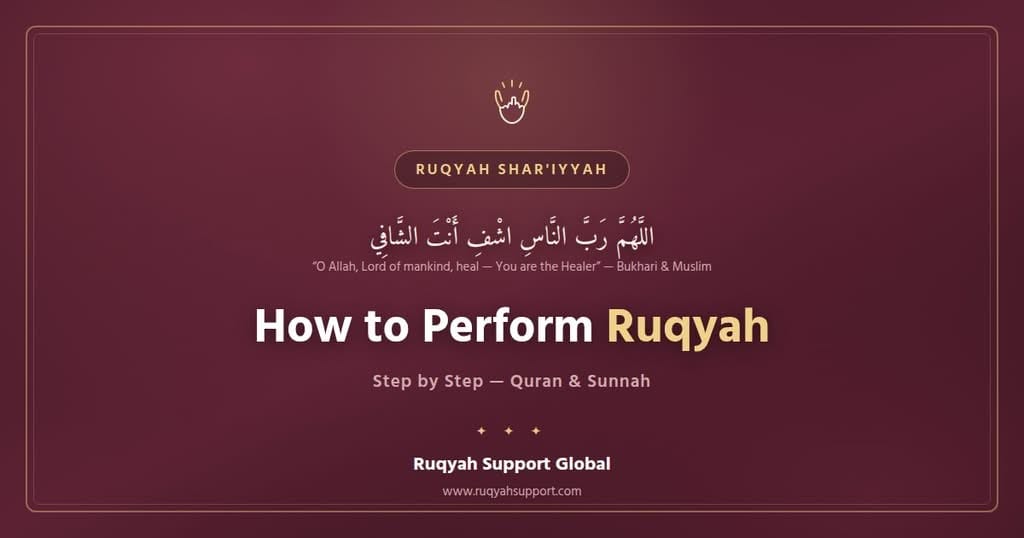
“Allahumma Rabban-nas, adhhibil-ba’s, ishfi antash-Shafi, la shifa’a illa shifa’uk, shifa’an la yughadiru saqama.”
“O Allah, Lord of mankind, remove the harm and heal, for You are the Healer. There is no cure except Your cure — a cure that leaves no illness behind.” (Sahih Bukhari & Muslim)
For a specific pain: place your hand on the area, say “Bismillah” three times, then say seven times: “A’udhu bi’izzatillahi wa qudratihi min sharri ma ajidu wa uhadhir” — “I seek refuge in the might and power of Allah from the evil of what I feel and fear.” (Sahih Muslim)
Ruqyah Water and Oil Method
Beyond reciting directly, another way of how to do ruqyah in Islam is over water and oil:
- Recite the verses and duas above over a container of water and some olive oil.
- Blow gently over them after reciting.
- Drink the recited water over several days and use it in bathing (ghusl).
- Apply the recited olive oil to the body.
How to Perform Ruqyah on Someone Else
To perform ruqyah on another person (a family member, for example):
- Recite the same verses and duas, directing the prophetic dua to them (“…arqik” — for you).
- Blow gently over them or place your hand on their head.
- Keep the person calm and encourage their own trust in Allah.
- For complex or long-standing cases, involve an experienced, shirk-free raqi.
How Often Should You Perform Ruqyah?
Self-ruqyah is best done daily — especially the three Quls in the morning and evening and before sleep. For an active problem, ruqyah can be performed once or twice a day with consistency. Improvement comes by the permission of Allah, so patience, regular worship, and sincerity are essential. Do not rush or expect instant results.
Common Mistakes to Avoid
- ❌ Going to sorcerers, fortune-tellers, or “kabiraj” — this is haram.
- ❌ Using amulets (taweez) or hanging them for protection.
- ❌ Reciting vague, unknown, or non-Quranic “spells”.
- ❌ Reciting mechanically without belief and presence of heart.
- ❌ Abandoning medical treatment — ruqyah is a complement, not a replacement.
Frequently Asked Questions (FAQ)
How do I perform ruqyah on myself?
Make wudu, recite Al-Fatihah, Ayatul Kursi, and the three Quls, add the prophetic duas, then blow into your hands and wipe over your body — with sincerity and trust in Allah.
How is ruqyah performed over water?
Recite the verses and duas over water and olive oil, blow gently, then drink the water, bathe with it, and apply the oil over several days.
Can I perform ruqyah for my family?
Yes. Recite over them and blow gently, directing the prophetic dua toward them. For complex cases, seek an experienced, shirk-free raqi.
How many times should I recite?
There is no fixed obligatory number; reciting the three Quls three times is common. Consistency matters more than a specific count.
Is ruqyah a replacement for medicine?
No. Ruqyah is a spiritual means alongside proper medical care. Healing comes only from Allah; the raqi and the doctor are both only guides.
Learn More
New to this topic? Start with What is Ruqyah in Islam? and see our Ruqyah Service page. For the primary sources, read the hadith on reciting the Mu’awwidhat before sleep and the ruqyah hadith in Sahih Muslim.
When to See a Raqi for Diagnosis
Self-ruqyah is excellent and encouraged. But if a problem is complex, long-standing, or you are unsure whether it is the evil eye, sihr, or the jinn, an experienced raqi can analyse the symptoms and the response to ruqyah to identify the real cause and guide you with an authentic, shirk-free method. A correct diagnosis prevents wasted time and the wrong approach.
✅ Targeted recitation: the right verses and duas for the problem.
✅ Shirk-free approach: entirely Quran- and Sunnah-based.
✅ Ongoing follow-up: guidance until recovery, by Allah’s will.
Book Your Online Ruqyah Session Today
Serving clients in the 🌍 USA, UK, Europe and worldwide via secure online WhatsApp sessions. Over 6 years of experience since 2020, with an authentic Quran- and Sunnah-based approach.
✨ We care, Allah cure.
✍️ Written by:
Raqi Muhammad Hasan
Director, Ad-Dua Ruqyah Center, Dhaka
Admin, Ruqyah Support Global
Providing authentic Quran- and Sunnah-based ruqyah and hijama services with over 6 years of experience since 2020.